马上注册,结交更多好友,享用更多功能,让你轻松玩转社区。
您需要 登录 才可以下载或查看,没有账号?立即注册
×
01最低预热温度确定原则 预热温度和道间温度应根据钢材的化学成分、接头的拘束状态、热输入大小、熔敷金属含氢量水平及所采用的焊接方法等因素综合考虑确定或进行焊接试验以确定实际工程结构施焊时的最低预热温度。 The preheating temperature and the temperature difference between layers should be determined based on factors such as the chemical composition of the steel, the restraint state of the joint, the size of the heat input, the hydrogen content level of the deposited metal, and the welding method used. Alternatively, welding tests should be conducted to determine the minimum preheating temperature for actual engineering structure welding.
常用结构钢材采用中等热输入焊接时,最低预热温度宜符合表2的规定。
When using medium heat input for welding common structural steel, the minimum preheating temperature should comply with the provisions in Table 2.
表2 常用结构钢材最低预热温度要求
Table 2 Minimum Preheating Temperature Requirements for Common Structural Steels常用钢材牌号 | 接头最厚部件的板厚t(mm)
t<20 | 20≤t≤40 | 40<t≤60 | 60<t≤80 | t>80 | Q235、Q295 | / | / | 40 | 50 | 80 | Q345 | / | 40 | 60 | 80 | 100 | Q390、Q420 | 20 | 60 | 80 | 100 | 120 | Q460 | 20 | 80 | 100 | 120 | 150 |
表注- “/”表示可不进行预热; "/" indicates that no preheating is required.
- 当采用非低氢焊接材料或焊接方法焊接时,预热温度应比该表规定的温度提高20℃; When using non-low-hydrogen welding materials or welding methods, the preheating temperature should be increased by 20℃ compared to the temperature specified in this table.
- 当母材施焊处温度低于0℃时,应将表中母材预热温度增加20℃,且应在焊接过程中保持这一最低道间温度; When the temperature at the welding site of the base material is lower than 0℃, the preheating temperature of the base material in the table should be increased by 20℃, and this minimum inter-pass temperature should be maintained throughout the welding process.
- 中等热输入指焊接热输入约为15~25kJ/cm,热输入每增大5 kJ/cm,预热温度可降低20℃; Medium heat input refers to a welding heat input of approximately 15 to 25 kJ/cm. For every 5 kJ/cm increase in heat input, the preheating temperature can be reduced by 20 degrees Celsius.
- 焊接接头板厚不同时,应按接头中较厚板的板厚选择最低预热温度和道间温度; When the thickness of the welded joint varies, the minimum preheating temperature and inter-pass temperature should be selected based on the thicker plate thickness of the joint.
- 焊接接头材质不同时,应按接头中较高强度、较高碳当量的钢材选择最低预热温度; When the materials of the welded joints are different, the lowest preheating temperature should be selected based on the steel with the higher strength and higher carbon content in the joint.
- 本表各值不适用于供货状态为调质处理的钢材;控轧控冷(热机械轧制)钢材最低预热温度可下降的数值由试验确定。 The values in this table are not applicable to steel with a supply condition of quenching and tempering treatment; the minimum preheating temperature that can be reduced for controlled rolling and controlled cooling (hot mechanical rolling) steel is determined by experiments.
02特殊焊接方法预热要求 3 电渣焊和气电立焊在环境温度为0℃以上施焊时可不进行预热;但板厚大于60mm时,宜对引弧区域的母材预热且不低于50℃。 When performing electroslag welding and gas tungsten arc vertical welding under an ambient temperature above 0℃, no preheating is required. However, when the plate thickness is greater than 60mm, it is advisable to preheat the base metal in the arc initiation area and the temperature should not be lower than 50℃.
03道间温度要求 4 焊接过程中,最低道间温度应不低于预热温度;静载结构焊接时,最大道间温度不宜超过250℃;周期性荷载结构和调质钢焊接时,最大道间温度不宜超过230℃。 During the welding process, the minimum inter-pass temperature should not be lower than the preheating temperature; for static load structures, the maximum inter-pass temperature should not exceed 250℃; for cyclic load structures and quenched and tempered steels, the maximum inter-pass temperature should not exceed 230℃.
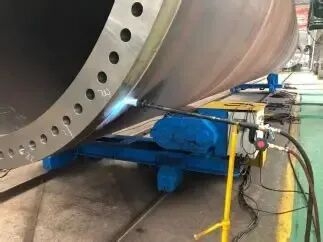
04预热及道间温度控制要求 5 预热及道间温度控制应符合下列规定:5. Preheating and inter-pass temperature control should comply with the following regulations:- 焊前预热及道间温度的保持宜采用电加热法、火焰加热法和红外线加热法等加热方法进行,并采用专用的测温仪器测量;Preheating and maintaining the inter-pass temperature should be carried out using heating methods such as electric heating, flame heating, and infrared heating, and should be measured using dedicated temperature measurement instruments;
- 预热的加热区域应在焊缝坡口两侧,宽度应为焊件施焊处板厚的1.5倍以上,且不小于100mm;预热温度宜在焊件受热面的背面测量,测量点应在离电弧经过前的焊接点各方向不小于75mm处;当采用火焰加热器预热时正面测温应在加热停止后进行。
The heating area for preheating should be on both sides of the weld bevel, with a width of more than 1.5 times the plate thickness at the welding site of the weldment, and not less than 100mm; The preheating temperature should be measured on the back side of the heated surface of the weldment, and the measurement points should be at least 75mm away from the welding point before the arc passes; When using a flame heater for preheating, the forward temperature measurement should be conducted after the heating stops.
05特殊钢材要求 6 Ⅲ、Ⅳ类钢材及调质钢的预热温度、道间温度的确定应符合钢厂提供的指导性参数要求。 For steel types Ⅲ and Ⅳ as well as quenched and tempered steel, the preheating temperature and inter-pass temperature should comply with the guiding parameters provided by the steel mill.
06说明 1 - 7最低预热温度和道间温度要求的原则是用以控制焊缝金属及邻近母材的冷却速度。较高的温度可使氢较快扩散且减少冷裂倾向。在给定条件下,未经预热的待焊焊接接头的冷却速度将高于预热的焊接接头。预热温度越高,冷却速度越低。当冷却速度足够缓慢时,将有效的减少硬化和裂纹倾向。
对调质钢而言,不希望较慢的冷却速度。且钢厂也不推荐如此。
规范中虽对最低预热温度和道间温度作出规定,但该数值仅根据常用钢材的实际钢材的化学成分水平、中等结构拘束度、常用的低氢焊接方法和焊接材料以及中等焊接线能量等条件给出的可避免焊接接头出现淬硬或裂缝的最低温度。实践及试验也证明,选择规范规定的最低预热温度和道间温度是可以防止一般拘束度接头焊接时裂纹的产生。而实际焊接时,为产生无裂纹、塑性好的焊接接头,预热和道间温度应高于规范规定的最低值。同时对道间温度的上限作出规定,是为了避免母材的过热而造成接头的脆化而降低接头的性能。
实际焊接时应根据钢材的化学成分、母材的强度等级、母材和焊材的碳当量水平、接头的拘束状态、焊接线能量大小、焊缝金属含氢量水平及所采用的焊接方法等因素综合进行判断或进行焊接试验以确定实际工程结构施焊时的最低预热温度。如果有充分的试验证据证明,选择的预热温度和道间温度足以防止接头焊接时裂纹的产生,可以选择低于表GB50661-7.6.2规定的最低预热和道间温度。
该规范中同时对预热的加热范围作出了规定,是为了确保接头使焊接接头预热温度均匀,冷却时具有平滑的冷却梯度,避免冷却速度较快。
电渣焊、气电立焊和栓钉焊,焊接线能量较大,焊接速度本身较慢,一般对焊接预热不作要求。
[Explanation]
The principle of the minimum preheating temperature and inter-pass temperature requirements from 1 to 7 is to control the cooling rate of the weld metal and the adjacent base metal. Higher temperatures can facilitate the diffusion of hydrogen and reduce the tendency for cold cracking. Under given conditions, the cooling rate of the unwelded welding joint without preheating will be higher than that of the preheated welding joint. The higher the preheating temperature, the lower the cooling rate. When the cooling rate is sufficiently slow, it will effectively reduce hardening and crack tendency.
For quenched and tempered steel, a slower cooling rate is not desired. And steel mills do not recommend such a practice either.
Although the minimum preheating temperature and inter-pass temperature are specified in the code, these values are only based on the actual chemical composition levels of common steels, moderate structural restraint, commonly used low-hydrogen welding methods and welding materials, and moderate welding line energy, etc., to provide the lowest temperature that can avoid the formation of hardening or cracks in the welding joint. Practice and experiments have also proved that choosing the minimum preheating temperature and inter-pass temperature specified in the code can prevent cracks from occurring in joints with general restraint during welding. However, during actual welding, to produce weld joints with no cracks and good plasticity, the preheating and inter-pass temperatures should be higher than the minimum values specified in the code. At the same time, an upper limit for the inter-pass temperature is specified to avoid overheating of the base material and cause the joint to become brittle and reduce the performance of the joint.
During actual welding, the minimum preheating temperature for the joint should be determined based on factors such as the chemical composition of the steel, the strength grade of the base material, the carbon equivalent level of the base material and welding material, the restraint state of the joint, the size of the welding line energy, the hydrogen content level of the weld metal, and the welding method used. If there is sufficient experimental evidence to prove that the selected preheating temperature and inter-pass temperature are sufficient to prevent cracks from occurring during joint welding, a preheating and inter-pass temperature lower than the minimum values specified in Table GB50661-7.6.2 can be selected.
The code also stipulates the heating range for preheating, to ensure that the preheating temperature of the joint is uniform, and during cooling, there is a smooth cooling gradient, avoiding a rapid cooling rate.
For electroslag welding, gas-electric vertical welding, and stud welding, the welding line energy is large, and the welding speed is generally slow. Generally, there are no requirements for welding preheating.
|
|

 提升卡
提升卡 置顶卡
置顶卡 沉默卡
沉默卡 喧嚣卡
喧嚣卡 变色卡
变色卡 抢沙发
抢沙发 千斤顶
千斤顶 显身卡
显身卡


 微信公众号
微信公众号 官方抖音号
官方抖音号