马上注册,结交更多好友,享用更多功能,让你轻松玩转社区。
您需要 登录 才可以下载或查看,没有账号?立即注册
×
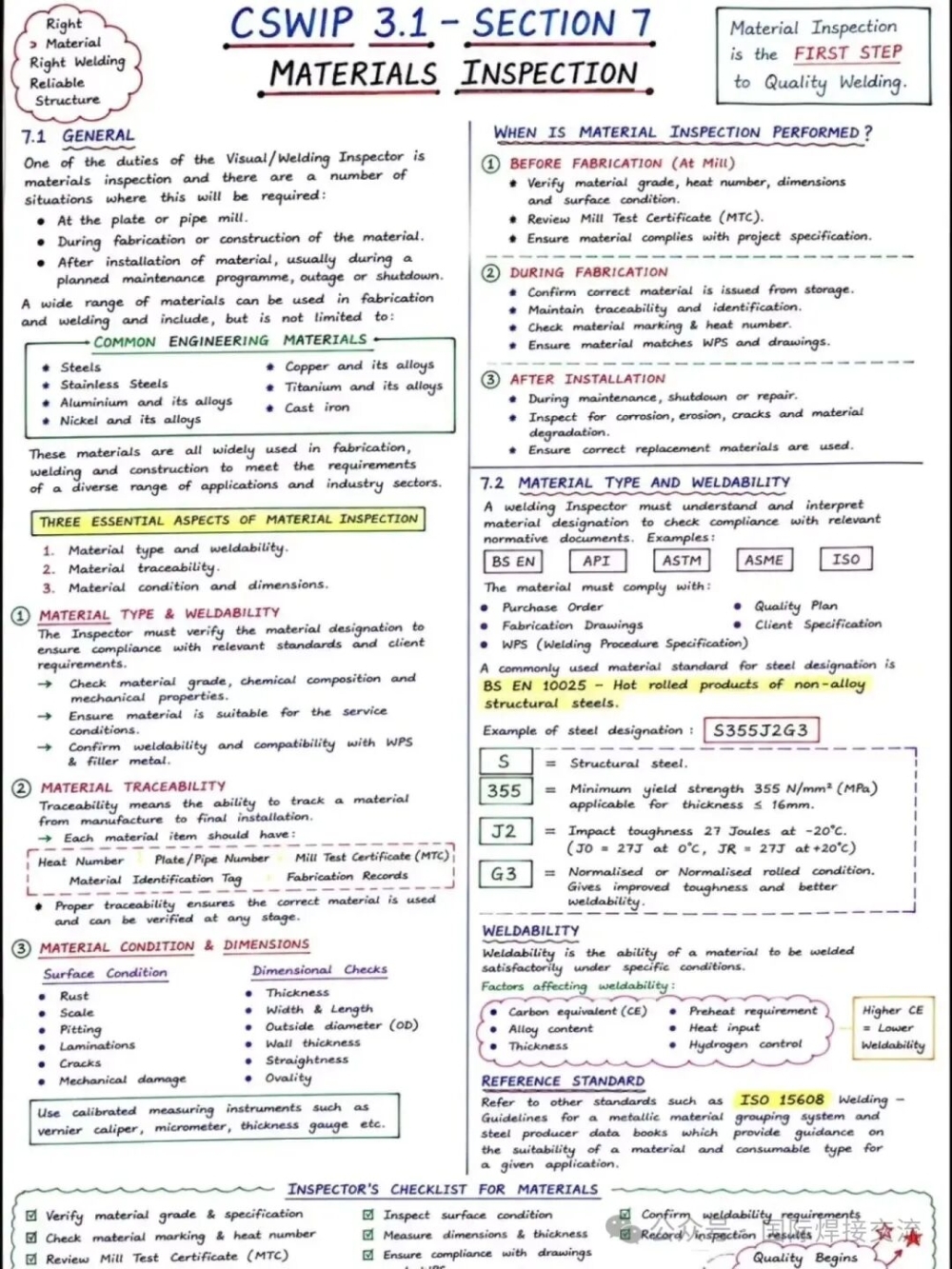
Material Inspection is the FIRST step to Quality Welding
材料检验是获得优质焊接的第一步
7.1 GENERAL|总则
One of the duties of the Visual/Welding Inspector is materials inspection and there are a number of situations where this will be required:
目视/焊接检验员的职责之一是材料检验,在多种场景下都需要开展该项工作:
- At the plate or pipe mill.|在板材或管材制造厂。
- During fabrication or construction of the material.|在材料制造与施工阶段。
- After installation of material, usually during a planned maintenance programme, outage or shutdown.|材料安装完成后,通常在计划性维保、停工检修期间。
A wide range of materials can be used in fabrication and welding and include, but is not limited to:
制造与焊接可使用种类繁多的材料,包括但不限于:
- Steels|钢
- Stainless Steels|不锈钢
- Aluminium and its alloys|铝及铝合金
- Nickel and its alloys|镍及镍合金
- Copper and its alloys|铜及铜合金
- Titanium and its alloys|钛及钛合金
- Cast iron|铸铁
These materials are all widely used in fabrication, welding and construction to meet the requirements of a diverse range of applications and industry sectors.
这些材料广泛应用于制造、焊接与工程建造领域,满足各行各业不同工况的使用需求。
THREE ESSENTIAL ASPECTS OF MATERIAL INSPECTION|材料检验三大核心要素
1. Material type and weldability|材料种类与可焊性
2. Material traceability|材料可追溯性
3. Material condition and dimensions|材料状态与尺寸
① MATERIAL TYPE & WELDABILITY|材料种类与可焊性
The Inspector must verify the material designation to ensure compliance with relevant standards and client requirements.
检验员必须核验材料牌号,确保材料符合相关标准与客户要求。
- Check material grade, chemical composition and mechanical properties.|核查材料等级、化学成分与力学性能。
- Ensure material is suitable for the service conditions.|确认材料适配服役工况。
- Confirm weldability and compatibility with WPS & filler metal.|确认材料可焊性,以及与WPS、填充金属的匹配性。
② MATERIAL TRACEABILITY|材料可追溯性
Traceability means the ability to track a material from manufacture to final installation.
可追溯性指能够追踪材料,从出厂直至最终安装就位。
Each material item should have:
每件材料都应具备:
- Heat Number / Plate/Pipe Number|炉号 / 板号/管号
- Mill Test Certificate (MTC)|出厂材质证明书(MTC)
- Material Identification Tag|材料标识标签
- Fabrication Records|加工记录
Proper traceability ensures the correct material is used and can be verified at any stage.
完善的可追溯体系保证全程使用正确材料,并可在任意阶段复核核验。
③ MATERIAL CONDITION & DIMENSIONS|材料表面状态与尺寸
Surface Condition|表面状态
Rust, Scale, Pitting, Laminations, Cracks, Mechanical damage
锈蚀、氧化皮、点蚀、分层、裂纹、机械损伤
Dimensional Checks|尺寸核查
Thickness, Width & Length, Outside diameter (OD), Wall thickness, Straightness, Ovality
厚度、宽度与长度、外径(OD)、壁厚、直线度、椭圆度
Use calibrated measuring instruments such as vernier caliper, micrometer, thickness gauge etc.
使用经校准的量具,例如游标卡尺、千分尺、测厚仪等。
WHEN IS MATERIAL INSPECTION PERFORMED?|材料检验实施时机
① BEFORE FABRICATION (At Mill)|制造前(钢厂阶段)
- Verify material grade, heat number, dimensions and surface condition.|核对材料牌号、炉号、尺寸及表面状态。
- Review Mill Test Certificate (MTC).|审核材质证明书(MTC)。
- Ensure material complies with project specification.|确认材料满足项目规范要求。
② DURING FABRICATION|制造过程中
- Confirm correct material is issued from storage.|确认从库房领用的材料牌号正确。
- Maintain traceability and identification.|保持材料的可追溯性与标识。
- Check material marking & heat number.|核查材料标记与炉号。
- Ensure material matches WPS and drawings.|确认材料与WPS、图纸保持一致。
③ AFTER INSTALLATION|安装完成后
- During maintenance, shutdown or repair.|维保、停机检修或维修阶段。
- Inspect for corrosion, erosion, cracks and material degradation.|检查腐蚀、冲蚀、裂纹以及材料劣化情况。
- Ensure correct replacement materials are used.|确保替换材料牌号正确。
7.2 MATERIAL TYPE AND WELDABILITY|材料类型与可焊性
A welding Inspector must understand and interpret material designation to check compliance with relevant documents. Examples: BS EN / API / ASTM / ASME / ISO
焊接检验员必须读懂、解析材料牌号,核对相关文件,常用标准体系:BS EN / API / ASTM / ASME / ISO
The material must comply with:
材料必须符合:
Purchase Order, Fabrication Drawings, WPS (Welding Procedure Specification), Quality Plan, Client Specification
采购订单、加工图纸、焊接工艺规程(WPS)、质量计划、客户规范
A commonly used material standard for steel designation is BS EN 10025 – Hot rolled products of non-alloy structural steels.
钢材牌号常用标准:BS EN 10025 非合金结构钢热轧产品
Example of steel designation: S355J2G3
钢材牌号示例:S355J2G3
- S = Structural steel|S = 结构钢
- 355 = Minimum yield strength 355 N/mm² (MPa) applicable for thickness ≤ 16mm.|355 = 最小屈服强度355 N/mm²(MPa),适用于厚度≤16mm
- J2 = Impact toughness 27 Joules at -20℃ (J0 = 27J at 0℃, J27 = 27J at +20℃)|J2 = -20℃冲击功27焦耳(J0代表0℃,J27代表+20℃)
- G3 = Normalised or Normalised rolled condition. Gives improved toughness and better weldability.|G3 = 正火或正火轧制状态,提升韧性、改善可焊性
WELDABILITY|可焊性
Weldability is the ability of a material to be welded satisfactorily under specific conditions.
可焊性:材料在特定焊接条件下,获得合格焊接接头的能力。
Factors affecting weldability:
影响可焊性的因素:
- Carbon equivalent (CE)|碳当量(CE)
- Alloy content|合金含量
- Preheat requirement|预热要求
- Heat input|热输入
- Hydrogen control|氢含量控制
Higher CE = Lower Weldability
碳当量越高 → 可焊性越差
Reference Standard: ISO 15608 Welding – Guidelines for a metallic material grouping system and steel product data books which provide guidance on the suitability of a material and consumable type for a given application.
参考标准:ISO 15608《焊接 — 金属材料分组体系指南》,钢材产品手册可指导母材与焊材在特定工况下的适用性。
INSPECTOR'S CHECKLIST FOR MATERIALS|检验员材料核查清单
✅ Verify material grade & specification|核查材料牌号与规范要求
✅ Check material marking & heat number|核对材料标记与炉号
✅ Review Mill Test Certificate (MTC)|审核材质证明书(MTC)
✅ Inspect surface condition|检查表面状态
✅ Measure dimensions & thickness|测量尺寸与厚度
✅ Ensure compliance with drawings|确认和图纸一致
✅ Confirm weldability requirements|确认可焊性相关要求
✅ Record inspection results|记录检验结果
Quality Begins质量始于此
|
|

 提升卡
 置顶卡
 沉默卡
 喧嚣卡
 变色卡
 抢沙发
 千斤顶
 显身卡



 微信公众号
 官方抖音号